The post Publication of a qualitative synthesis review: A building block for effective advocacy for health equity appeared first on Health Gradient.
]]>Led by EuroHealthNet, this work aimed to consolidate existing knowledge of advocacy for health equity, which is dispersed widely across the academic and grey literature, across disciplines, and is contained in a variety of different kinds of publications. Advocates previously had no synthesis of this knowledge to draw upon to inform their efforts.
As a result, EuroHealthNet carried out a systematic review of the academic literature and fixed-length systematic search of the grey. The results of the search which were analysed and synthesised by using a heuristic representation of advocacy for health equity (the "Six Dimensions of Advocacy for Health Equity"), developed jointly with the European Anti-Poverty Network, Business in the Community and Eurochild.
The review shows that the policy world is complex and that scientific evidence is unlikely to be conclusive in the making of decisions policy. Timely qualitative, interdisciplinary, and mixed-methods research may be particularly valuable in advocacy efforts. The potential impact of evidence can be increased by “packaging” it using methods of knowledge transfer and translation. Increased contact between researchers and policy makers could improve the uptake of research in policy processes. Researchers can play a role in advocacy efforts, though health professionals and disadvantaged people, who have direct contact with - or experience of - hardship, can be particularly persuasive in advocacy efforts. Different types of advocacy messages can accompany evidence, but messages should be tailored to the target group. Advocates need to take advantage of “windows of opportunity”, which open and close quickly, and demonstrate expertise and credibility. For this reason, dedicated advocacy organisations that have the resources and experience required to advocate could play a leading role in advocacy efforts, bridging the ‘worlds’ of science, practice and policy.
One surprise finding was the emphasis on barriers that hamper advocacy efforts in the academic literature. The most frequently cited was the current political and economic zeitgeist (variously termed 'market fundamentalism', 'market justice', 'neo-classical economics' and 'neoliberalism') and related public opinion, which tends to blame disadvantaged people for their ill health. Other barriers identified included biomedical approaches to health, market-led reforms of higher education, academic difficulties or reluctance to advocate and political short-termism. Several papers suggested means of overcoming these barriers, including long-term actions to raise public awareness and understanding of the SDH, training health professionals in advocacy or human rights, and bringing students concerned with the determinants of health into closer contact with those experiencing hardship as part of their studies.
The review provided a useful building block for later research on advocacy within DRIVERS: five case studies on advocacy and development of the toolkit on advocacy for health equity. In addition, the findings helped inform the how the project disseminated and presented its results. The paper is available here, and appendices here. The case studies report is available here, and advocacy for health equity toolkit here.
The post Publication of a qualitative synthesis review: A building block for effective advocacy for health equity appeared first on Health Gradient.
]]>The post Low maternal education predicts poor health among babies appeared first on Health Gradient.
]]>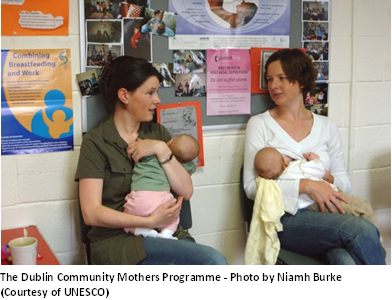 The first years of life are crucial in building the foundation for health and well-being throughout childhood and in later life. The DRIVERS project has focused on early childhood as one of three key policy areas for improving health equity in Europe. Although a healthy start to life is a major priority across European countries, the regional-level evidence of inequalities in health among newborns is limited.
A large-scale study, led by Milagros Ruiz from University College London as a part of DRIVERS, sought to advance the state-of-the-art knowledge in this area. The study examined the health of over 75,000 babies from 12 countries (Czech Republic, Finland, France, Greece, Italy, the Netherlands, Norway, Portugal, Spain, Sweden, the United Kingdom and Ukraine) representative of the cultural, geographical and historical diversity across Europe. The study looked at the effect of low maternal education upon babies’ risk of being born either too soon, or too small for their gestational age.
The study found that low maternal education was linked with a discernible risk of pre-term and small for gestational age births in Europe. There is substantial evidence that both preterm (and small for gestational age) births are critical aspects of foetal nutrition and health among newborns. In fact, these aspects have been attributed to impaired child development and an increased risk of chronic diseases in adult life. On average, the increased risk of poor health at birth associated with low maternal education was 48% greater for preterm births and 55% greater for small for gestational age births across 12 countries.
However, the associations between low maternal education and poor health at birth within each country were most robust in the Netherlands, Spain, Sweden and the UK, for both health outcomes. These associations were weaker in the other countries studied. The study authors are continuing their work for DRIVERS, and are further assessing the differential effect of mother’s education as a social determinant of newborn health in participating countries.
These findings provide a clearer picture of inequalities in newborn health associating with low maternal education in distinct European settings. Such inequalities may be alleviated by universal and high-quality care and education for babies and their families, which would contribute to creating more supportive environments for disadvantaged communities.
The study published in the Journal of Epidemiology and Community Health, ‘Mother's education and the risk of preterm and small for gestational age birth: a DRIVERS meta-analysis of 12 European cohorts’, can be accessed here: http://jech.bmj.com/content/early/2015/04/23/jech-2014-205387.long.
The post Low maternal education predicts poor health among babies appeared first on Health Gradient.
]]>The post Lower education leads to a more stressful working life; labour market policies can mitigate this appeared first on Health Gradient.
]]>These findings held even when adjusting for factors such as occupation – meaning even those in the same job had reduced stress if they had attained a higher level of education. Importantly, integrative labour market policies, such as training for the unemployed, had a greater association with lower stress levels than more passive policies (those based around job loss compensation e.g. early retirement/unemployment benefits). This is possibly a result of integrative policies’ tendency to target disadvantaged groups, and having greater impact in terms of lowering overall labour market disadvantage. With work-related stress leading to reduced physical and mental health, this study provides evidence that policy makers should step up investments in protective and integrative labour market policies to reduce health inequalities.
The study: ‘The Association between Education and Work Stress: Does the Policy Context Matter?’ can be found here: http://journals.plos.org/plosone/article?id=10.1371/journal.pone.0121573.
The post Lower education leads to a more stressful working life; labour market policies can mitigate this appeared first on Health Gradient.
]]>The post DRIVERS policy briefs to improve health equity through policy and practice appeared first on Health Gradient.
]]>They gather the latest evidence from the project, provide a synopsis of the issue, solutions, and opportunities to advocate. The briefs have been informed by the findings of work on advocacy for health equity, and are meant for policy makers and practitioners at the European, national and sub-national levels. Translations of the policy briefs into several different European languages are under way, and will be made available from the Translations page.
Download links:
- Early Child Development - Universal, quality early childhood programmes that are responsive to need promote better and more equal outcomes in childhood and later life.
- Fair Employment - Improvements in quality of work, particularly for people in lower occupational groups, would contribute to a significantly healthier and more productive Europe.
- Income & Social Protection - Well-designed social protection systems can improve the lives of people and reduce health inequalities.
Slideshare links:
The post DRIVERS policy briefs to improve health equity through policy and practice appeared first on Health Gradient.
]]>The post European policy makers support DRIVERS solutions to tackle health inequalities appeared first on Health Gradient.
]]> The event, co-hosted by Julie Ward MEP (S&D, UK) and Eider Gardiazabal Rubial MEP (S&D, ES), brought together European and national policy-makers, civil society, industry and academics to discuss how DRIVERS’ latest evidence can be taken forward and integrated into existing and future policy initiatives.
For more than three years, scientists, civil society organisations, and representatives from public health and businesses have collaborated to explore how health equity can be improved across policy sectors, through action on three of the most important drivers of health: early childhood, employment & working conditions, and income & social protection.
As a result of their efforts, DRIVERS has identified four principles by which decision makers can design better and ‘healthier’ policies addressing the challenges of our time to help create a fairer Europe. These overarching principles can be applied to any policy context and can bring potential added value especially during times of crisis and cuts to public social spending.
Prof. Sir Michael Marmot in his keynote speech outlined how the principles of ensuring universalit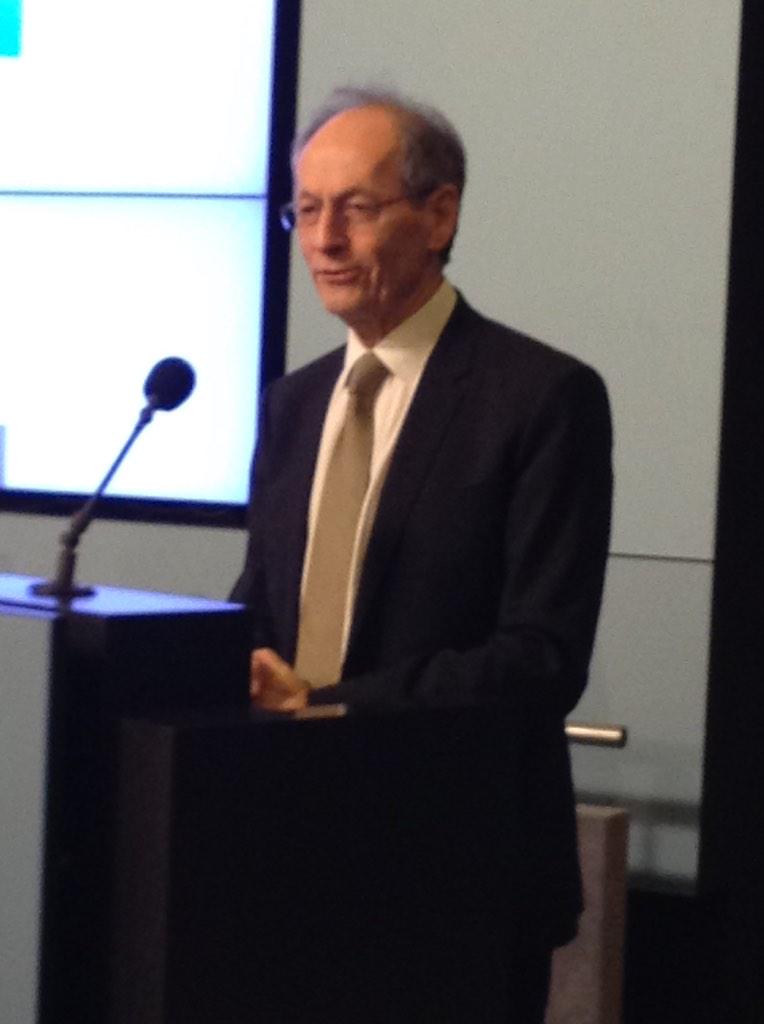 y of access to services while addressing disadvantage, accounting for context and respecting rights of people concerned and ensuring that policies are evidence-based can guide the development and implementation of policies to improve health and reduce health inequalities.
Application of these principles would enable children and families to live better and have adequate social protection coverage, enable workers to stay in the labour market for longer, improve productivity at work, reduce social exclusion and, hence, foster greater social cohesion.
The importance of the life-course should be taken into account in the application of these principles as social inequalities start having an impact on individuals before birth, through early childhood and through life, influencing later life chances and outcomes. Moreover, the systematic deprivation of health for certain social groups, denying them the possibility to participate fully in economic and social life, results in even worse health.
The conference was composed of a scientific and a policy expert panel. During the first panel on taking stock of the evidence base advanced by DRIVERS, representatives from three DRIVERS’ partners (University of Dusseldorf, Centre for Health Equity Studies & University College London) explained how the DRIVERS project enabled them to gain new insights on employment, social protection and early child development & inequalities within and between different EU countries. 
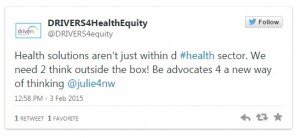 Throughout the discussions, there was a general consensus that solutions to improve health equity solutions do not simply reside within the health sector and that public spending should strengthen sustainable employment and address health-adverse working conditions.
Moreover, other messages echoed that more spending on active labour market policies is correlated with better jobs and lower health inequalities in the same way that more spending on unemployment benefits is linked to a narrower social gradient in health.
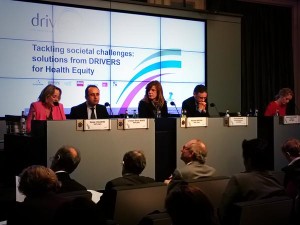
In the panel dedicated to policy and how recommendations from DRIVERS can be taken forward to inform EU policy agendas, members of the European Parliament argued that the European Parliament's work can help improve health, but real moves towards health equity require action across sectors and at different levels of governance.
The DRIVERS policy recommendations received broad support and endorsement and several EU policy makers, including a member of the Social Protection Committee, and made concrete proposals and commitments to taking them forward.
Conference co-host Eider Gardiazabal Rubial MEP pledged to make efforts to ensure that the Commission and the Council boost investment in social and health needs and continue to tackle inequalities rather than allow a widening of existing disparities as a result of the crisis.
Ralf Jacob (DG EMPL, European Commission) stated that DRIVERS’ recommendations are in synergy with many of the Commissions priority areas. He also argued that the mid-term review of the Europe2020 Strategy represents a real opportunity for using new knowledge to inform the next phase of the Strategy.
All in all, the conference was an excellent opportunity to disseminate the latest pan-European evidence arising from the DRIVERS project and stimulate debate on how action to help reduce health inequalities across sectors can be maximized.
Reducing inequalities and enhancing social cohesion during this economic climate requires collective commitment and co-operation. DRIVERS and EuroHealthNet, a network of agencies and organisations dedicated to improving health equity across Europe, would like to thank all those who have supported us in the execution of our work within DRIVERS. Following the conference, interviews were conducted with several of our speakers. Video footage will be available soon.
“DRIVERS’ recommendations are impressive, very detailed, evidence-based, and integrated across the life course…” Rudi Van Dam (Social Protection Committee)
Did you miss the DRIVERS conference and want to know more? Please visit our Storify page (see below), which summarises the conference key messages that were produced via Twitter.
The news release issued following the conference can be found here.
The key note speech by Sir Michael Marmot can be found here.
The policy recommendations document 'Improving health equity through action across the life course' can be found here.
More information on DRIVERS publications (policy briefs, reports) can be found here. The policy recommendations and policy briefs are currently being translated into several European languages and will be available shortly.
For more information, please contact us at [email protected]




















































The post European policy makers support DRIVERS solutions to tackle health inequalities appeared first on Health Gradient.
]]>The post “It is time to break the link between disadvantage & poor outcomes” – EV Healthcare features DRIVERS appeared first on Health Gradient.
]]>Pressure mounts for added focus on how social context impacts on health outcomes
An ambitious call to improve Europeans' health by major shifts in social spending marked the conclusion of the EU-funded "Drivers for health equality" project in early February. "It is time to break the link between disadvantage and poor outcomes", UK epidemiologist Michael Marmot told a meeting in Brussels organised by EuroHealthNet, the project coordinator. Outlining the findings that early childhood, employment, and income and social protection were crucial factors in health, he said the evidence was clear, "but a lot of policymakers couldn't care less about evidence-based policies". Marmot, who will take over as president of the World Medical Association this year, made clear that he intends to take the message to colleagues: "Doctors should think about real health determinants", he said.
The project's recommendations include the familiar call for coherent policy responses across governments, ranging from wider access to welfare and education to interventions in the workplace and deeper research. Marmot argued that this project could have an effect. "Can we do anything about it? Yes we can!", he said. Despite the powerful "countervailing forces" – he cited increased inequality and the record levels of concentration of wealth – "people are listening ", he insisted, and at the most senior levels of government the recognition is growing that extreme inequalities are unacceptable. But the consequences could be a realignment of where power over health policy lies, he suggested. The actions of finance ministers in redistribution of wealth through social protection initiatives could have a more dramatic positive impact on citizens' health than many classic health-focused policies.
Reproduced with permission. Copyright 2014 by European Voice SA.
EV Healthcare is a "fortnightly professional email newsletter, (which) gives a unique insight into policy formation among national and European authorities, the healthcare industries, the research community, and patient organisations".
The post “It is time to break the link between disadvantage & poor outcomes” – EV Healthcare features DRIVERS appeared first on Health Gradient.
]]>The post DRIVERS reports on early child development, employment & working conditions, and income & social protection appeared first on Health Gradient.
]]>They detail the scientific work carried out by teams at University College London/UCL Institute of Health Equity, the Department of Medical Sociology at Universität Düsseldorf, and the Centre for Health Equity Studies (CHESS) at Stockholms Universitet, on (respectively) early child development, employment & working conditions, and income & social protection.
While numerous academic papers have been - and continue to be - published in leading peer-reviewed journals, these reports bring together the expanded evidence base, explaining how the different pieces of work fit together and provide a solid foundation for the development of evidence-based recommendations. These recommendations are detailed in separately published recommendations document and three policy briefs.
The three reports are:
- Social Inequalities in early childhood health and development, evidence and policy implications, by Hynek Pikhart, Milagros Ruiz, Joana Morrison, Peter Goldblatt & Michael Marmot. Also see the Appendices.
- Working conditions and health inequalities, evidence and policy implications, by Johannes Siegrist, Diego Montano & Hanno Hoven.
- The role of income and social protection for inequalities in health, evidence and policy implications, by Olle Lundberg, Monica Åberg Yngwe, Kersti Bergqvist & Ola Sjöberg.
The project's final recommendations will be presented tomorrow, 3 February 2015, at a conference held at the Residence Palace in Brussels. The final recommendations document and policy briefs are available from the publications section of the website.
The post DRIVERS reports on early child development, employment & working conditions, and income & social protection appeared first on Health Gradient.
]]>The post DRIVERS contributes to discussions on advocacy and tackling health inequalities at the 7th annual European Public Health Conference appeared first on Health Gradient.
]]>DRIVERS participated in several pre-conference sessions, during which project partners presented some key findings of the project and discussed the role of effective advocacy in realising health equity goals.
A session titled “How to tackle health inequalities? Results from four EU-funded projects” saw Prof Olle Lundberg (CHESS) illustrate the limitations of a welfare regime approach to studying social protection and health inequalities. It also saw Dr Hynek Pikhart (UCL) underline methodological and conceptual challenges in the harmonisation of inequality-relevant indicators across Europe.
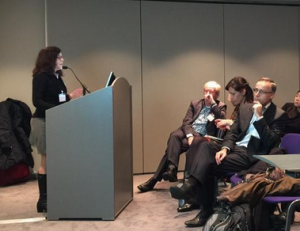 Dr Claudia Marinetti (EuroHealthNet) gave an overview of the role of advocacy in reducing health inequalities. She emphasised the value of different kinds of evidence in advocacy efforts, in contrast to the well-known ‘hierarchy of evidence’, and the use of different types of advocacy messages.
In a poster walk dedicated to evidence-informed policy, Linden Farrer (EuroHealthNet) presented results from DRIVERS on improving the effectiveness of advocacy for health equity. He stated that it is important for evidence to find its way into policy processes, but doing so requires specific methods of knowledge transfer and translation. As scientists are not always willing or able to advocate, knowledge brokering organisations such as EuroHealthNet can play an extremely important role in facilitating this process.
One of DRIVERS’ aims is to identify solutions to reducing health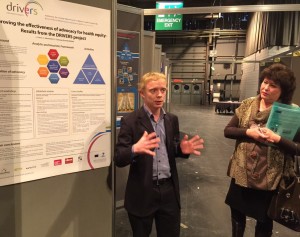 inequalities through policy and practice in early childhood development. Joana Morrison (UCL) presented a review of early childhood interventions in several European countries conducted over the last two decades with the aim of addressing health and early development. One of the findings is that interventions with better outcomes appear to combine educational activities for both parents and children beginning in early pregnancy and include home visits by specialised staff.
DRIVERS also featured in a packed plenary session on tackling health inequalities organised by EuroHealthNet. The session included a discussion on presenting policy recommendations to policy makers from four EU-funded projects (DEMETRIQ, DRIVERS, SILNE, SOPHIE), all aiming to generate new evidence on the best ways of tackling health inequalities.
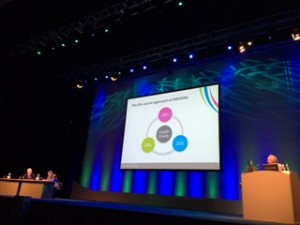 On behalf of the DRIVERS team, Prof Johannes Siegrist emphasised that public spending should strengthen sustainable employment and address health-adverse working conditions, particularly among lower socio-economic groups. Indeed, he noted that “DRIVERS has demonstrated a social gradient in risk of suffering from work stress, with lower occupational groups facing the greatest risks of psycho-social stress”.
All in all, the EPH conference was an excellent opportunity to disseminate new evidence arising from the DRIVERS project to public health researchers, policy makers, practitioners and health professionals.
If you missed DRIVERS at the EPH conference then please visit our Storify page (see below), which summarises the key events through the tweets that were produced throughout the course of the Pre-conference.
You can find the joint DRIVERS and EuroHealthNet news release issued at the start of the EPH Pre-Conference here.
You can also find the DRIVERS presentations and poster here.
The post DRIVERS contributes to discussions on advocacy and tackling health inequalities at the 7th annual European Public Health Conference appeared first on Health Gradient.
]]>The post Important stakeholders provide valuable input and feedback to DRIVERS’ policy recommendations appeared first on Health Gradient.
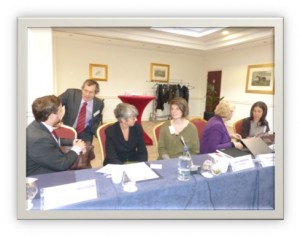
]]>The stakeholders represented the: Belgian Federal Public Service (FPS) for Health, Convention of Scottish Local Authorities (COSLA), European Federation of Public Service Unions (EPSU), European Agency for Safety and Health at Work (EU-OSHA), European Commission DG Education and Culture (EAC), DG Employment, Social Affairs & Inclusion (EMPL), DG Justice (JUST) and DG Research & Innovation (RTD), International Labour Organization (ILO), the Network of European Foundations (NEF), Organisation for Economic Co-operation and Development (OECD), Permanent Representation of the Slovak Republic to the European Union, Social Platform and Vlaams Instituut voor Gezondheidspromotie en Ziektepreventie (ViGEZ).
The aim of the event was to take stock of the research findings and to refine and hone project recommendations. It was therefore an excellent opportunity to receive feedback on the overall package of research and policy links developed by the project to date, raise the profile of the project among key stakeholders and to broaden the potential base of support.
Clive Needle (EuroHealthNet) chaired the seminar and led the round-table discussions on how to maximise the impact of the project’s recommendations in policy processes. Participants were invited to share their views and provided feedback on how DRIVERS could contribute to processes at the EU, national and sub-national levels beyond the lifetime of the project.
Introducing the project’s approach to promoting health equity, Peter Goldblatt, (Institute of Health Equity, UCL) described the importance of taking a life-course approach in understanding the three DRIVERS areas, and how carefully implemented interventions and policies in these areas can improve health equity. These were based on four key principles: universality, responding to disadvantage, adaptation to context, and drawing on data from different sources and countering the ‘information paradox’ (whereby the least data exists for countries with the greatest need to reduce health inequalities).
The seminar sparked interesting and fruitful discussions on how to bridge the gap between research and policy and there was focused debate on how recommendations could be tailored to different audiences.
Project partners welcome the valuable suggestions put forward by the seminar’s participants and will take them into full consideration in developing the final recommendations and other dissemination activities.
Seminar presentations are available here.
For more information please contact us at: [email protected]
The post Important stakeholders provide valuable input and feedback to DRIVERS’ policy recommendations appeared first on Health Gradient.
]]>